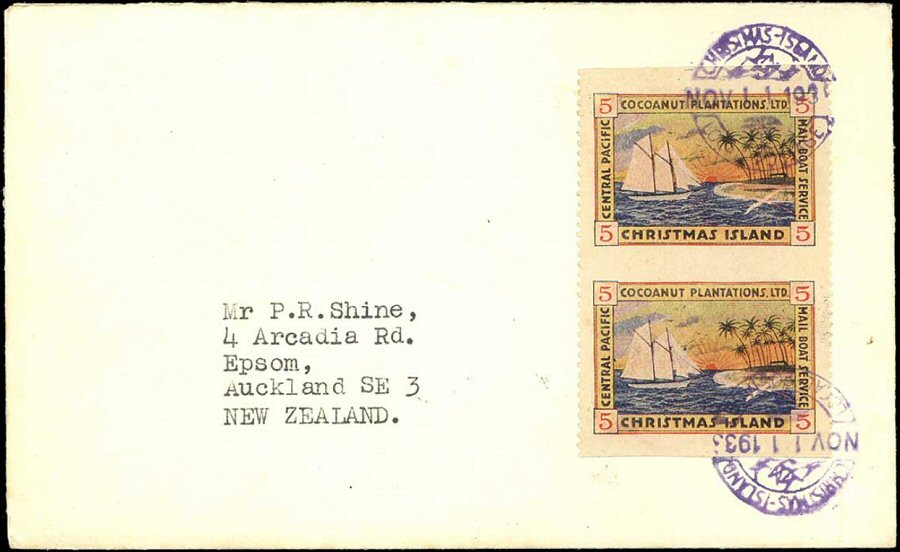
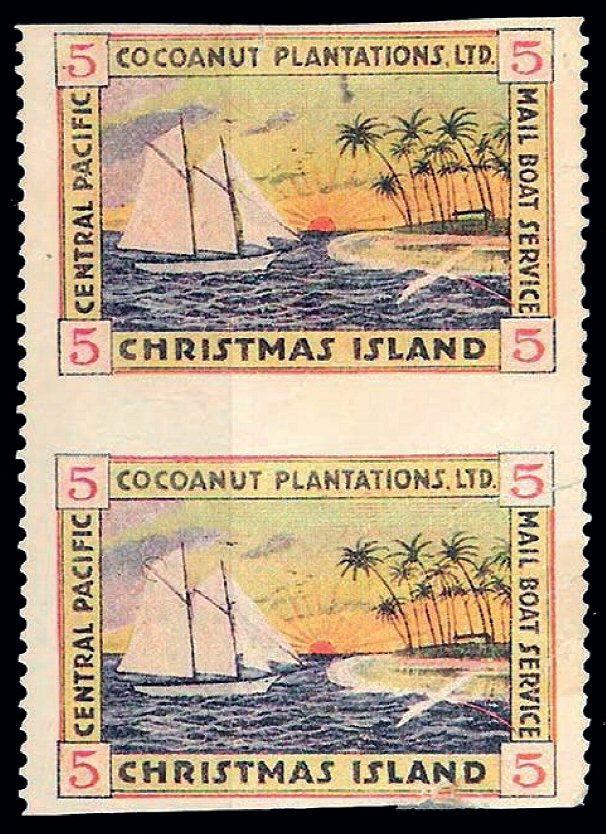
This is a cover with a vertical pair the horizontal perforation missing.
The cover was auctioned by Grosvenor Philatelic Auctions London in sale #40 on 22 May 1008 for £700.
The lot description was:
Gilbert and Ellice Islands: Cancellations and Covers: Christmas Island: Locals: 1933 (Nov. 11) ''Jerabek''
envelope to Auckland, bearing 1924 2nd Issue 5c. vertical pair [Pos. 1, 3] showing variety imperf. horizontally,
tied by violet type 54 cancellations and backstamped Epsom Christmas Day arrival.
11. November 1933
The following is an article on the unperforated plantation locals:
From the October 2015 issue of the PISC's quarterly PACIFICA:
Pacific Islands Study Circle.
Imperforated Christmas Island Locals - Genuine or Forged?
By James Mulik and Ingomar Janot
Hello friends and collectors of Christmas Island locals 1916 - 1938. Much has been written about Fr.Rougier's Christmas Island local stamps, but one aspect of these stamps
that is not well researched are the imperforated varieties of these stamps.
One of the first publications to mention the imperforated stamps was The Cinderella Philatelist (p.
31) from April 1983:
 'In Christmas Island and its Postal History by the Pacific Islands Circle of the Royal Sydney
Philatelic Club, page 12, dealing with the first issue (5 cents perf. 12½, an extract from
Roessler's Stamp News of 1920 is quoted from the Australian Philatelic Record, vol. 3, p. 278
(January 1921) which not only mentioned sheets of eight (2x4) but goes on to elaborate: "A
few are known part perforated". As stated, that refers to the first issue. That brings me to the
question of the issue date of the second issue. Is it a possibility that the second issue was in
existence in 1920 when Roessler wrote in his journal? This notion is strengthened by the
existence of a cancelled block of four with margins on three sides (not on top) with the
inscription in the right margin "Christmas Is/12-3-22".'
'In Christmas Island and its Postal History by the Pacific Islands Circle of the Royal Sydney
Philatelic Club, page 12, dealing with the first issue (5 cents perf. 12½, an extract from
Roessler's Stamp News of 1920 is quoted from the Australian Philatelic Record, vol. 3, p. 278
(January 1921) which not only mentioned sheets of eight (2x4) but goes on to elaborate: "A
few are known part perforated". As stated, that refers to the first issue. That brings me to the
question of the issue date of the second issue. Is it a possibility that the second issue was in
existence in 1920 when Roessler wrote in his journal? This notion is strengthened by the
existence of a cancelled block of four with margins on three sides (not on top) with the
inscription in the right margin "Christmas Is/12-3-22".'
Since 1983, though, it appears that little else has been reported about these imperforated stamps. But,
within the last two years three different sets of imperf pairs of the Christmas Island locals have been
offered at auction. Prior to these three sets being offered, only one imperf pair was previously known.
All of these imperf pairs are from the second issue of the 5 cent stamp, and photos of these four imperf
pairs are in the Appendix to this article.
While these imperf pairs are not unfamiliar to Christmas Island local collectors, what about single
imperforated Christmas island stamps?
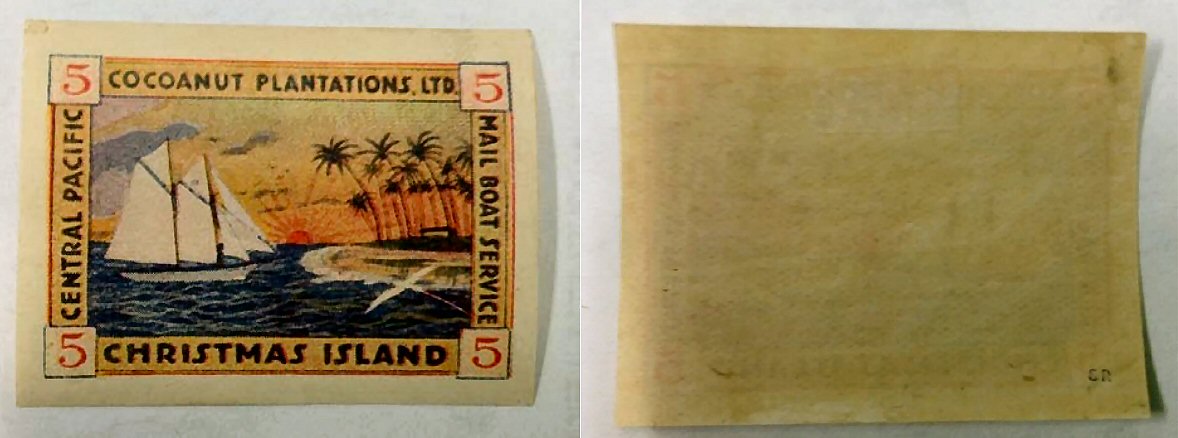
Some time ago I (J.M) bought a small collection of Christmas Island local single stamps, and one of
these stamps was without perforations. My stamp is printed on thin paper, as evident by curling of
the paper. In addition, my stamp has the initials SR on the reverse. At right is illustrated the front and
back of this stamp:
imperforate
Front and back imperforate
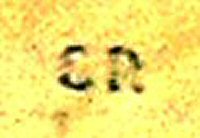
SR on reverse
In 2013 while discussing this matter with another member of the Pacific Islands Study Circle (I.R,
who is a Christmas Island locals collector), I mentioned my imperf stamp to him. I scanned my
imperforated stamp, sent it to him, and asked for his opinion. He told me that he believed that this
stamp was most likely a forgery, but that more research was needed.
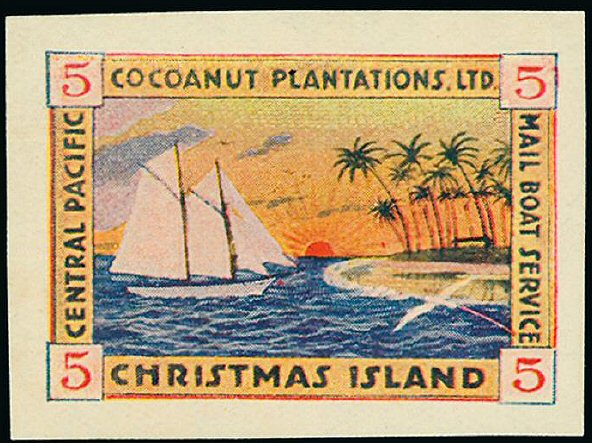
imperforate
Since 2013, both of us have conducted a lot more
research about the Christmas Islands locals, and we
were surprised to see another imperf Christmas
Island single stamp offered at auction in November
2014. The auction catalogue described the stamp
as a "1924 2nd issue 5c imperforate single, fine
mint, scarce." An illustration of the imperf stamp
from the auction is shown at left:
With photos of two different imperf singles, we
decided to intensify our investigation to determine
if the stamps are genuine or forged. We scanned
blocks of four the first and second local issues of
stamps, and we began digitally overlaying the
imperf stamp from the auction onto the various plate positions. For my imperf stamp, I (J.M) was
able to physically overlay it onto the various plate positions. This method, whilst not perfect, did
provide us with enough information to proceed with the investigation.
Conclusions
Based upon our investigations, we believe that it is highly likely that my (J.M) imperf stamp is from
the second plate position of the first issue Christmas Island local (i.e., plate position 1,2). In addition,
we believe that the imperf stamp from the auction (above) is from the first plate position of the first
issue (i.e., plate position 1,1).
In addition, we believe that even though the margins of both imperf stamps are different sizes, the
margins of both imperf examples are small enough to have been forged by cutting off the perforation
of a first issue Christmas Island local - particularly since the first issue stamps had much larger
margins compared to the subsequent second, third, and fourth issues, but the printed area of the stamps
have remained the same on each issue.
Below are images that support our likely conclusion that these imperforated stamps are in fact
forgeries:
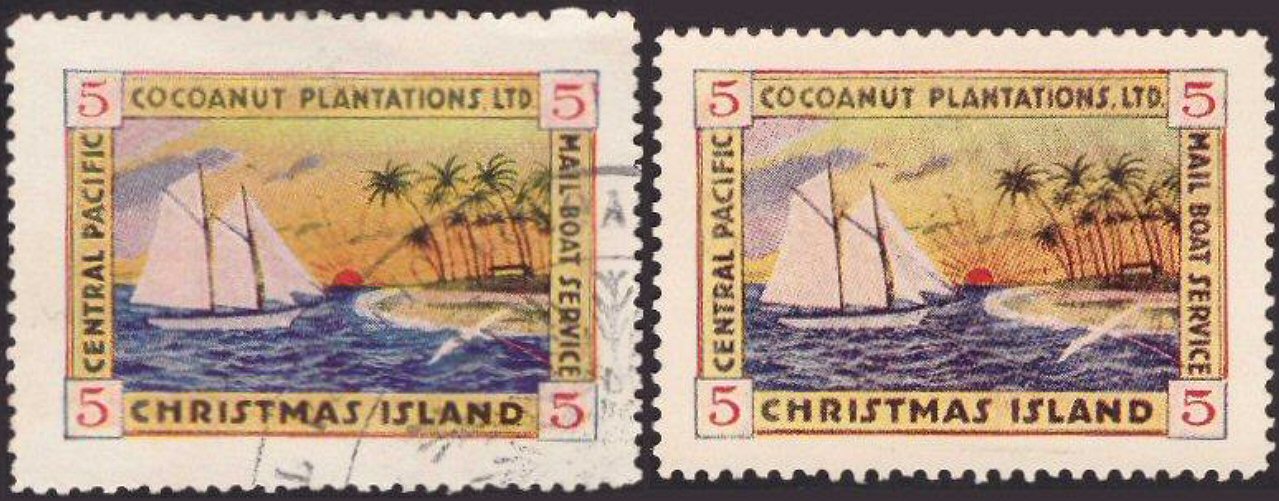
5c stamps
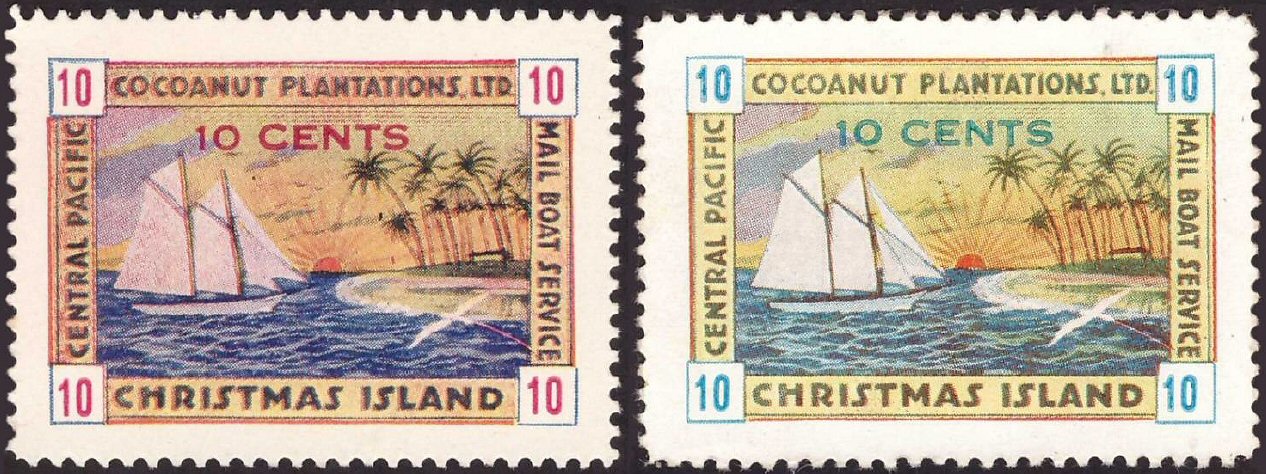
10c stamps
#1: A scan of one stamp of each issue. It can clearly be seen that the stamp of the first issue (far left)
has larger margins than the other three issues.
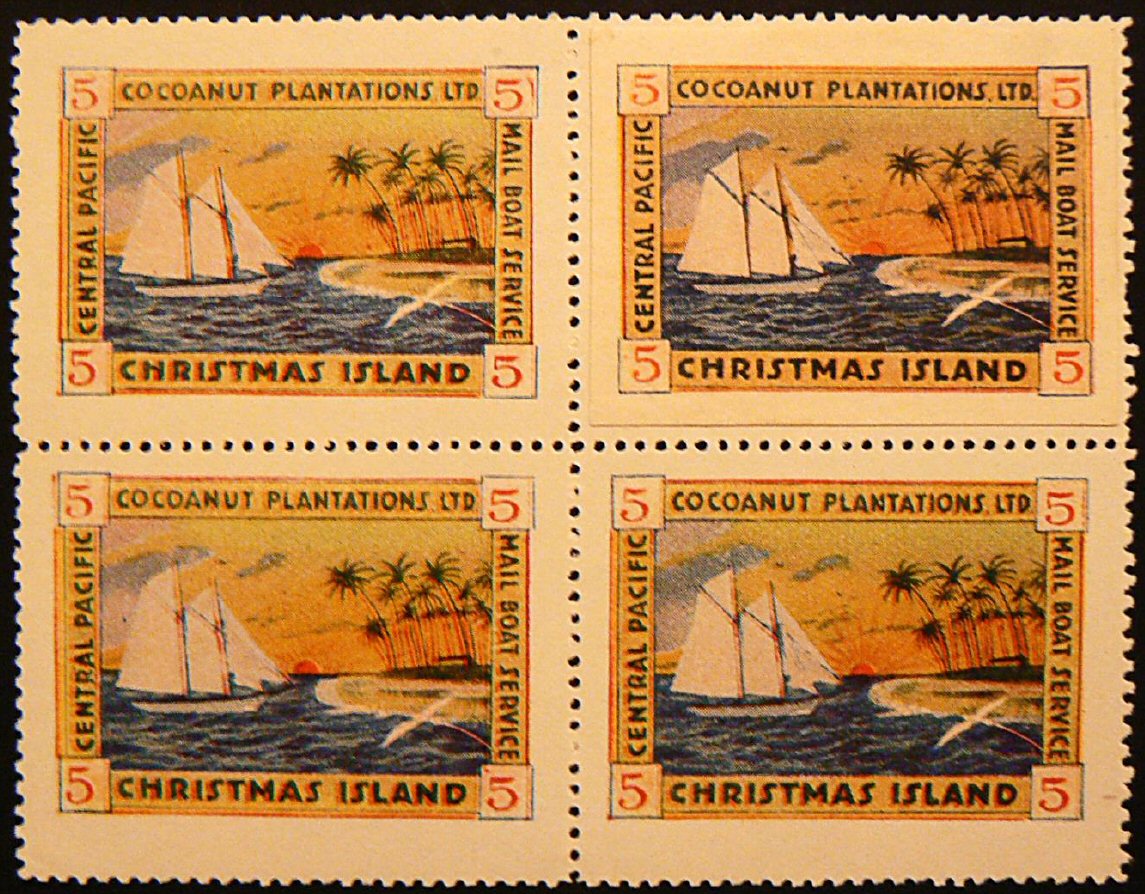
four 5c stamps with pos 1.2
imperf on top
Left: #2: My (J.M) sheet of four, first issue stamps with my imperforated stamp superimposed at plate position 1,2.
In our comparison we do not argue with colours because different scanners do not reproduce them
identically. However, as additional information, the colours of the first and second issues, according
to Keith Fitchett, are as follows:
1st issue: 5c blue, orange, red, green and black
2nd issue: 5c blue, yellow-orange, red, green and black
Right: #3: My colleague's (I.J) sheet of four, 1st issue stamps with the auction's imperforated stamp
superimposed at plate position 1.1.
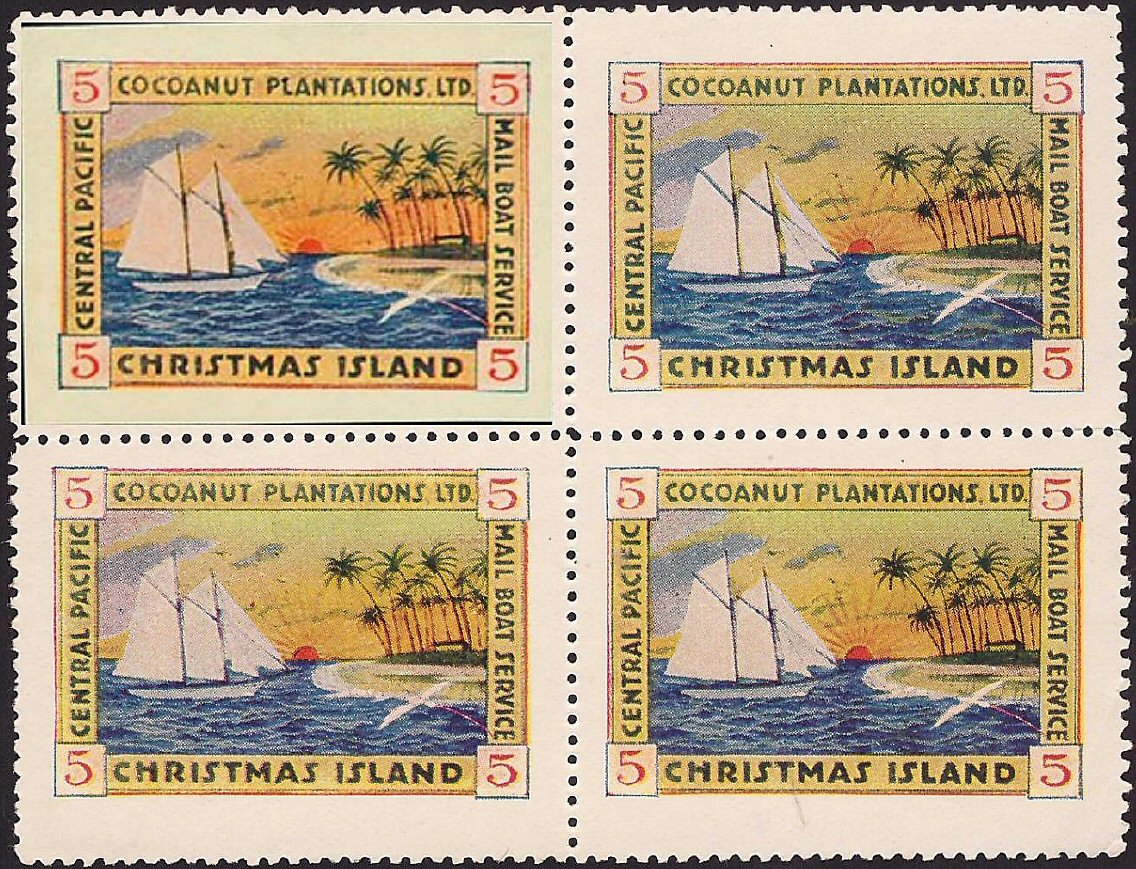
four 5c stamps with pos 1.1
imperf on top
Remaining Questions
While our investigation leads us to believe that the two imperf single stamps have been forged by having the
perforations removed, there are a few remaining questions that prevent us from definitely making this claim.
These questions are below:
1. If the stamps are from the first issue Christmas Island local, why is the paper a bit thinner than the first
issue stamps and why does the paper of the imperf stamp curl easily, which is not a characteristic of
the first issue stamp?
2. If the stamps are from the first issue Christmas Island local, why would the auction house believe that
its imperf stamp was from the second issue of the locals? Surely the auction has handled many
Christmas Island local stamps before and would be able to determine the colour difference between
the first and second issue stamps.
3. Does the SR imprinted on the back of my stamp provide any useful information in helping solve the
mystery as to whether the imperf stamp is genuine or forged? (For example, L N Williams' "company
history" of the Central Pacific Cocoanut Plantations, Ltd. appears to state that a man named Rougier
Stanislaus was the company director from 15 June 1914 to 27 July 1915 and was listed as an additional
director in 1921. Could the SR mark on the reverse of my imperf stamp be connected to the Rougier
Stanislaus mentioned in Williams' company history? An illustration of Williams' notes at right:
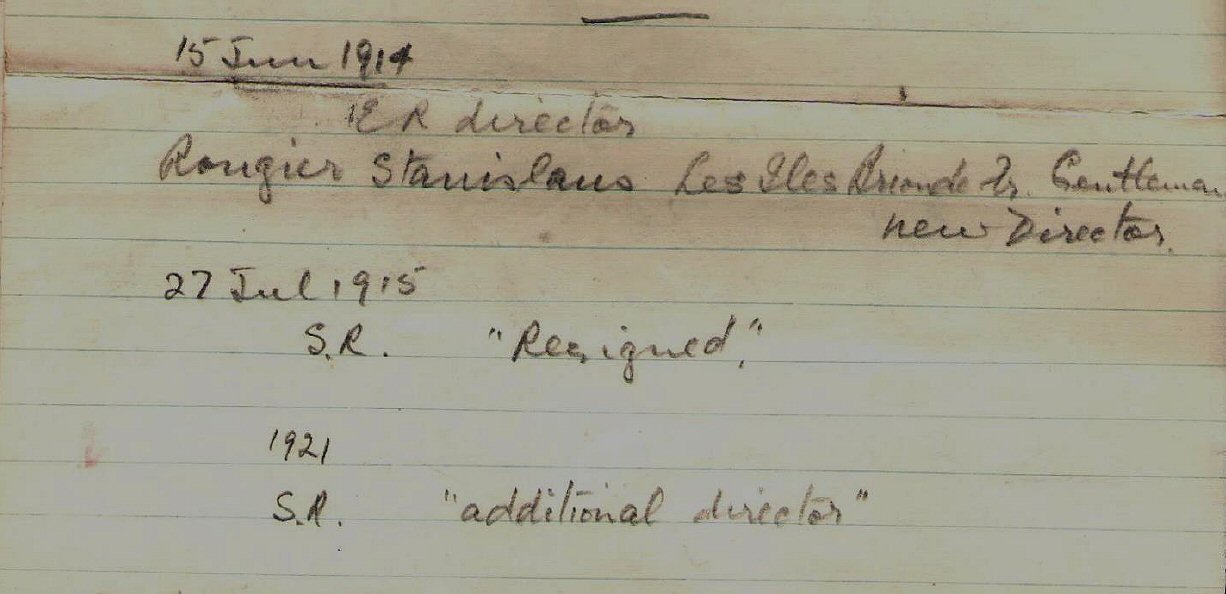
notice in Williams' records
Or perhaps the SR imprinted on the reverse is simply a mark that a former owner placed on the
stamp.
In light of the information presented above, we would encourage readers to weigh in on the discussion and ask
additional questions. Finally we would like to acknowledge the contributions made by Roland Klinger and
Per-Arno Hansen (both PISC members) to this article.
Appendix
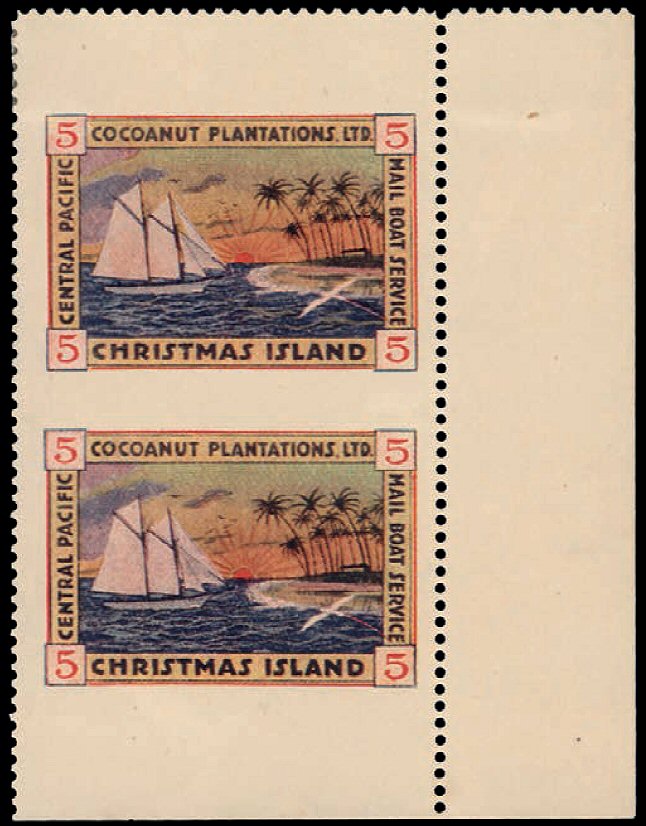
5c imperforate pair
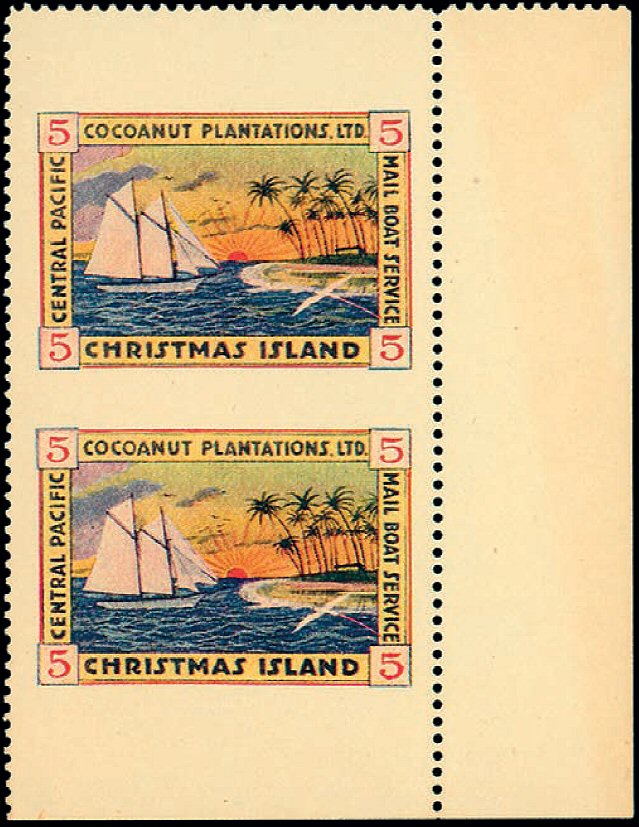
5c imperforate pair
5c imperforate pair
This pair of imperf locals was sold at
auction in August 2014.
This pair of imperf locals was sold at
auction in November 2014.
The pair of imperf locals shown above was
mentioned and pictured on p. 31 of the April
1983 publication of The Cinderella Philatelist.
If you have imperforate examples of the "Cocoanut
Plantations" stamps, either on or off cover, we
would be pleased to hear from you.
Contact either Jim Mulik or Ingomar Janot direct
imperforate
Front and back imperforate
SR on reverse
imperforate
With photos of two different imperf singles, we decided to intensify our investigation to determine if the stamps are genuine or forged. We scanned blocks of four the first and second local issues of stamps, and we began digitally overlaying the imperf stamp from the auction onto the various plate positions. For my imperf stamp, I (J.M) was able to physically overlay it onto the various plate positions. This method, whilst not perfect, did provide us with enough information to proceed with the investigation.
5c stamps
10c stamps
four 5c stamps with pos 1.2
imperf on top
In our comparison we do not argue with colours because different scanners do not reproduce them identically. However, as additional information, the colours of the first and second issues, according to Keith Fitchett, are as follows: 1st issue: 5c blue, orange, red, green and black 2nd issue: 5c blue, yellow-orange, red, green and black
Right: #3: My colleague's (I.J) sheet of four, 1st issue stamps with the auction's imperforated stamp superimposed at plate position 1.1.
four 5c stamps with pos 1.1
imperf on top
notice in Williams' records
In light of the information presented above, we would encourage readers to weigh in on the discussion and ask additional questions. Finally we would like to acknowledge the contributions made by Roland Klinger and Per-Arno Hansen (both PISC members) to this article.
5c imperforate pair
5c imperforate pair
5c imperforate pair